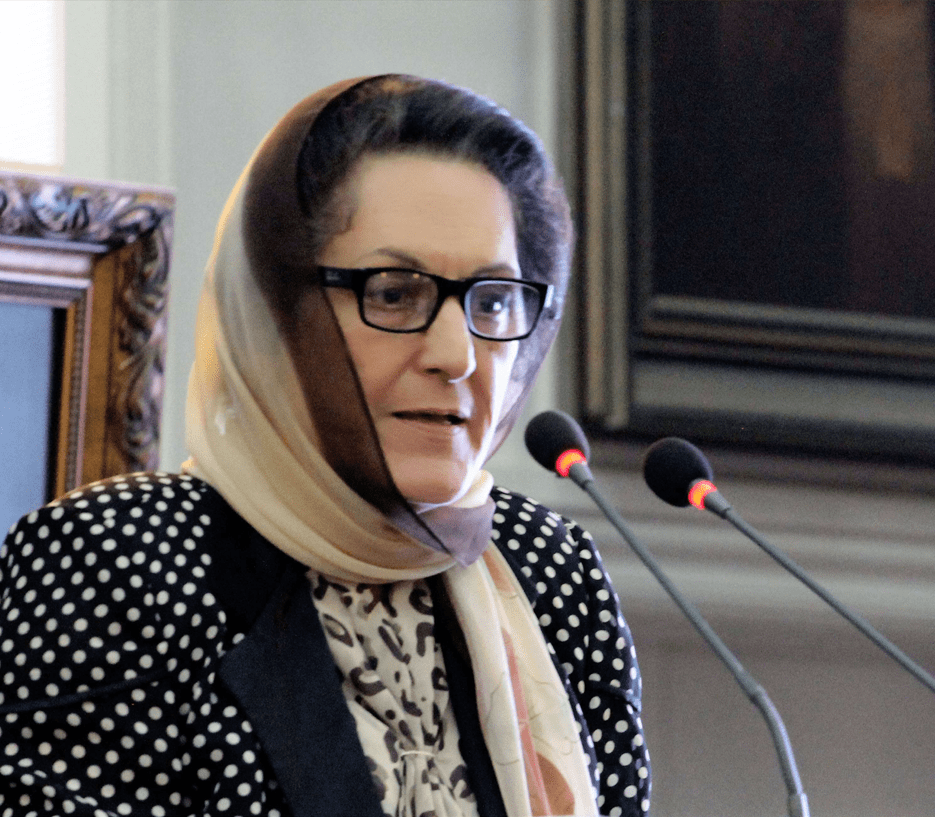
Shafiqa Habibi is one of the most prominent cultural, media, and social women of Afghanistan. She has the honor of serving as a radio and television announcer, declaimer, teacher, civil activist, and member of the High Peace Council. She was born in Afghanistan in 1320 Hijri Shamsi
Personal Life
She grew up in a family of scholars and culture, and from childhood she showed great interest in books, poetry, music, and the art of oratory. She received her primary and higher education in Kabul and soon became known among the younger generation as an exceptional talent in the field of language and expression.
Shafiqa Habibi’s family is originally from Logar Province, Afghanistan, but Shafiqa Habibi grew up in Kabul and received her bachelor’s degree in journalism from Kabul University. She is married to Mahmud Habibi. He has served in various positions, including Senate chairman, minister, and governor during the monarchy, the First Republic, the People’s Democratic Party, and the presidency of Dr. Najibullah.
Media and professional activities
The turning point in Shafiqa Habibi’s life was joining the National Radio and Television of Afghanistan in the 1960s. She quickly gained national fame due to her resonant, standard voice and eloquent expression, earning her titles such as “Umm al-Balagha (The Laureate of All Orators),” “Lady of the Golden Voice,” and the title of “The Chosen Dari Announcer.” Her performances in literary and cultural programs were not only artistic but also served as a platform for informal education in literature and culture among the community. In this field, she was able to create a link between classical literature, contemporary poetry, and the masses of the people.
Social activities and women’s rights
Beyond the media, Shafiqa Habibi was a prolific social activist. Focusing on women’s rights and social justice, she played a key role in combating violence, discrimination, and inequality against women.
During the Mujahideen era, she assumed the presidency of the Association of Sisters of Journalists of National Television and Afghan Film. As a women’s rights activist, she expanded her field of activity from radio, television, and Afghan film to achieve legitimate women’s rights. When the Taliban took power in Afghanistan in 1996, and women and girls were deprived of work and education, she established the Afghanistan Feminine Association in 1999, which ran home-based handicraft schools. After establishing this institution, she was forced to leave the country and went to Peshawar, but she made several secret trips to Kabul through numerous land trips to advance the affairs of her institution, and in the process, she gave interviews to various domestic and international publications. In total, Ms. Habibi established eight handicraft schools, where women learned crafts such as embroidery, sewing, and beadwork. These schools were kept secret from the government.
After the Taliban were overthrown in 2001, she worked as the head of broadcast at the Independent Commission of Human Rights in Afghanistan for a short time. She then changed the name of the Afghan Feminine Association to the New Afghan Women’s Association (NAWA) and upgraded literacy schools to literacy programs and accelerated education programs. The organization has also carried out great work in the field of combating sexual violence against women and children, such as documenting violence and carrying out awareness programs.
Ms. Shafiqa Habibi is the founder of the first “Women Journalists Union” in the history of the country’s press, and established this union on March 8, 2005. Later, this union was officially renamed the Afghan Women Journalists Union. This union is also one of the founding members of the Federation of Afghan Journalists. This association also published the monthly magazine Women Journalists.
Another of her most important activities was her participation in the establishment of the “Federation of Afghan Journalists” in 2005. This organization was able to bring together dozens of female journalists and media activists and play an important role in strengthening the position of women in the media. Later, she also became a board member of the Afghan Women’s Network (AWN), where, along with other board members, she participated in resolving the cases of violence against women, advocating for women’s rights, and making decisions regarding the activities of women’s rights organizations.
Shafiqa Habibi repeatedly emphasized the importance of educating girls and trained hundreds of Afghan girls in eloquence and expression, encouraging them to continue their education and pursue their dreams.
Role in the national and international arena
Her role for peace: Ms. Habibi started working as a member of the Executive Board of the High Peace Council in 2016 and played a major role in holding the National Consensus of Afghan Women for Peace, in which a total of 15,000 women from all provinces of Afghanistan participated.
Shafiqa Habibi’s activities were not limited to Afghanistan. She attended national and international meetings and gatherings, such as the Afghan Women Summit 2001, and, on behalf of Afghan women, made their voices heard around the world. She received awards from domestic and international institutions, including the United Nations, for her ongoing efforts for freedom of expression and human rights.
Awards and Letters of appreciation
Shafiqa Habibi is a well-known intellectual and human rights activist to the general masses. In 2002, she was awarded the Courage in Journalism Award of Ida B. Wells in New York. Additionally, the nonprofit organization Women’s eNews recognized her activities as a woman journalist and human rights activist, amongst the 21 Leaders for the 21st Century, along with other women journalists. In 2005, she was amongst the thousands of women nominees for the Nobel Peace Prize as well.
Achievements and intellectual legacy
Shafiqa Habibi has become a role model for future generations through her media, social, and cultural activities. Her work, whether in the form of television and radio performances or in her speeches and writings, carries messages of justice, freedom, and awareness. She is a clear example of a woman who, with her voice, broke the wall of imposed silence and strengthened the culture of resistance among the Afghan women’s community.
Conclusion
Shafiqa’s life reflects an Afghan woman’s struggle against changing political systems and difficult social conditions. She has played a lasting role not only in the media arena but also in the field of social justice and advocacy for women’s rights. Her legacy remains today as an inspiring role model for scholars, social activists, and the younger generation of Afghanistan.
 ویبسایت رسمی خانم شفیقه حبیبی - Shafiqa Habibi's Official Website
Leave a comment